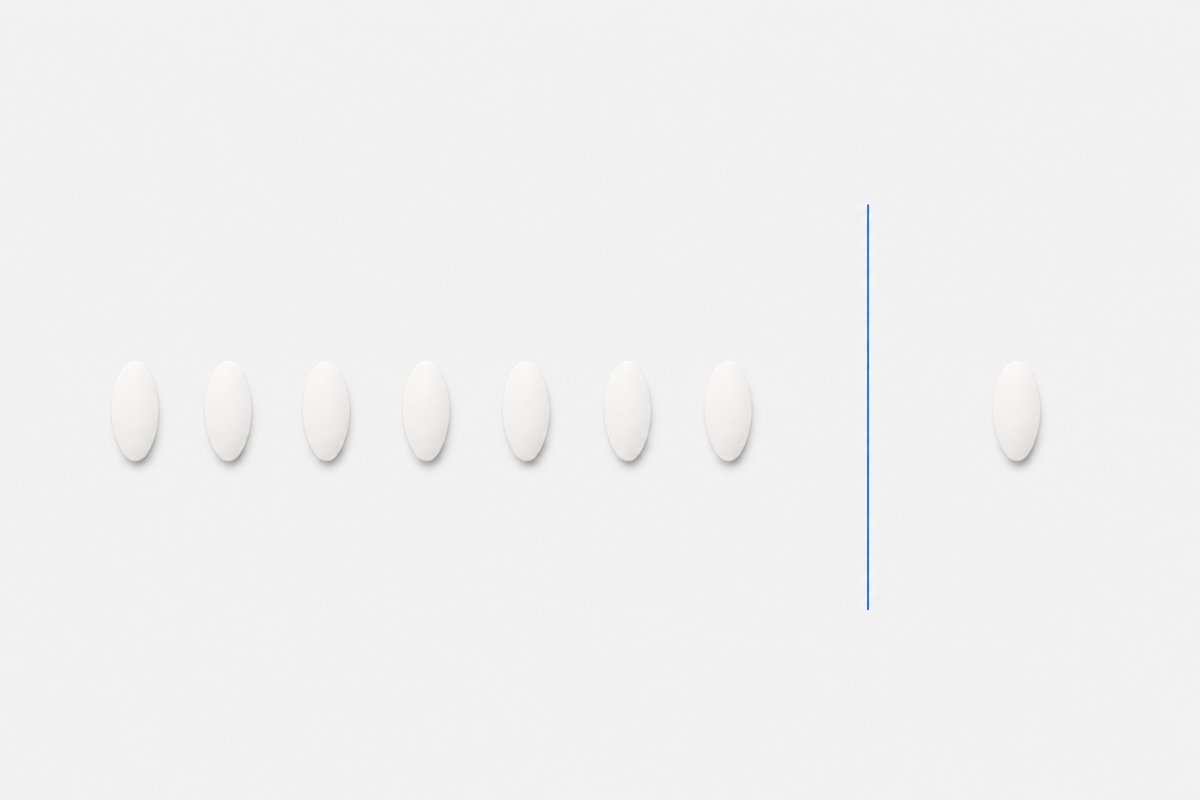
One 10 mg tablet on a Friday covers my whole weekend. Is there any reason to move to 5 mg every day?
The label carries two tadalafil products under one generic name
One molecule, four strengths, two prescriptions that the label keeps apart.
Both regimens, figures from the US prescribing information
As-needed start10 mg, adjustable to 5 or 20 mg
Once-daily start2.5 mg for ED; 5 mg with the prostate
CeilingOne tablet in 24 hours, either regimen
Peak concentrationMedian 2 hours, range 30 minutes to 6
Terminal half-life17.5 hours
Steady stateDay 5, about 1.6 times a single dose
FoodNo restriction
NitratesContraindicated; 48 hours before emergency use
Tadalafil reaches the pharmacy as 2.5, 5, 10 and 20 mg film-coated tablets, and the prescribing information splits them into dosing sections that barely reference each other. Use as needed: 10 mg before anticipated sexual activity, raised to 20 mg or lowered to 5 mg on individual response and tolerability. Once-daily use: 2.5 mg at roughly the same hour every day for erectile dysfunction, increased to 5 mg if 2.5 is thin, and 5 mg flat when an enlarged prostate is being treated as well. Both regimens stop at one tablet in any 24 hours.
No part of the label describes a man running both.
Men are usually handed this as a strength question, the small tablet or the big one, which wastes the decision. What is being chosen is whether the drug is present because tonight was foreseen or present because it is always present, and the answer comes out of a calendar and a prostate rather than out of milligrams.
Everything below follows from that split: how many tablets a month, whether an evening has to be predicted, whether urinary symptoms get treated in the same prescription, and how long before a verdict is fair.
The 36-hour figure came out of trials that told men when to try
Both studies worked the same way: they took the choice of timing away from the man.
| Attempt timed at | Placebo | Tadalafil 10 mg | Tadalafil 20 mg | 10 mg over placebo |
|---|---|---|---|---|
| 24 hours after dosing | 42% | 56% | 67% | +14 points |
| 36 hours after dosing | 33% | 56% | 62% | +23 points |
The first study randomised 348 men with erectile dysfunction to placebo or tadalafil 20 mg and asked for four attempts: two around the 24-hour mark, two separate ones at 36. In the 33 to 39 hour window, 88 of 137 men on tadalafil reported at least one success, 64 percent, against 49 of 133 on placebo, 37 percent.
The second is the more useful one, because it separated 10 mg from 20 mg and counted attempts rather than men. 483 patients, six groups, a dose and an hour assigned to each. At 24 hours the mean per-patient share of successful attempts ran 42 percent on placebo, 56 on 10 mg, 67 on 20 mg. At 36 hours: 33, 56 and 62 percent.
Read the 10 mg column twice. It sits at 56 percent at both timepoints while placebo falls from 42 to 33, which describes a shallow tail rather than a cliff at hour 36. The same data quietly corrects the front end of the slogan as well. Peak concentration lands at a median of 2 hours, and individual men in the pharmacokinetic work peaked anywhere between 30 minutes and 6 hours, so a tablet swallowed as the evening starts is still on the way up.
Terminal half-life is 17.5 hours. That one number carries the whole design.
A daily tablet cannot be judged before the fifth day
Exposure climbs for most of a week and then flattens. Verdicts before that are noise.
Day 1
As-needed dosing is at full strength. Daily dosing is nowhere near its plateau.
Day 5
Daily exposure flattens at roughly 1.6 times a single dose. Nothing earlier is a fair test.
Week 4
The step from 2.5 to 5 mg gets decided here.
Week 12
Where the once-daily and prostate trials reported, and a sensible review point.
Steady-state plasma concentrations on once-daily tadalafil arrive within five days, and exposure at that point sits about 1.6-fold above a single tablet. A man who starts 2.5 or 5 mg on Monday and writes the drug off on Tuesday night has tested it at roughly two-thirds of the level it was licensed at.
The efficacy evidence for daily dosing is separate from the 36-hour work and was gathered under a different rule: no instruction at all about when sex should happen relative to the tablet. In the 24-week United States study, men on 5 mg maintained an erection through intercourse in 57 percent of attempts at endpoint against 31 percent on placebo, with the erectile function domain moving 7.0 points against 1.2. On 2.5 mg the same two measures read 50 percent and 6.1 points. The 12-week study run outside the United States came in higher again, 67 against 37 percent and 9.7 points against 0.9.
Those 2.5 mg numbers are why the label starts low and allows a step up instead of putting everyone on 5. Most of the effect is already there at the smaller tablet, and headache and back ache scale with dose, so some men genuinely end up better served by 2.5.
Diabetes narrows the margin. In the dedicated once-daily trial in 298 men with type 1 or type 2 diabetes, endpoint success was 46 percent on 2.5 mg and 41 percent on 5 mg against 28 percent on placebo. Still a real gain, clearly smaller, and better said before someone is disappointed than after.
Kidneys, liver and CYP3A4 rewrite whichever number you picked
Renal and interaction limits here are written as milligrams per interval, not milligrams per tablet.
Where the number changes, and where the interval does
- Creatinine clearance 30 to 50 mL/min, as needed: start 5 mg no more than once a day, maximum 10 mg no more than once in 48 hours.
- Creatinine clearance under 30 mL/min or on haemodialysis, as needed: maximum 5 mg no more than once in 72 hours. Once-daily use is not recommended at all.
- Creatinine clearance 30 to 50 mL/min, once daily: start 2.5 mg, step to 5 mg on individual response.
- Potent CYP3A4 inhibitor such as ritonavir, ketoconazole or itraconazole: as needed, no more than 10 mg once every 72 hours. Once daily, a ceiling of 2.5 mg.
- Mild or moderate hepatic impairment, Child-Pugh A or B: as-needed dosing must not exceed 10 mg. Daily dosing has not been evaluated properly in this group.
- Severe hepatic impairment, Child-Pugh C: the drug is not recommended on either regimen.
Most of the entries above do not shrink the tablet. They stretch the gap between tablets, and two of them delete a whole regimen rather than reduce it.
Anyone on a protease inhibitor or a 400 mg azole should read that CYP3A4 line twice. A 72-hour interval turns as-needed tadalafil into a planned drug, and the 2.5 mg ceiling removes the step to 5 mg that most of the daily efficacy data came from.
Strong inducers push the opposite way. Rifampin cuts exposure, and the label offers no upward adjustment to compensate, so a man on rifampicin who reports nothing happening has not necessarily failed the drug class. Men get moved to injections on the strength of that confusion.
Dinner is irrelevant on this molecule; the wine is not
The only PDE5 tablet in common use with no meal instruction attached.
Tadalafil tablets may be taken without regard to food on either regimen. No fasting, no waiting after a meal, no calculation about how fatty the main course was. That is a real practical advantage over sildenafil, where a high-fat meal delays the peak by an hour and takes 29 percent off it, and it is one of the ordinary reasons men end up on this molecule rather than that one.
Alcohol is a different question and the label is explicit that tadalafil can potentiate the blood-pressure-lowering effect of alcohol. Substantial drinking, the amount that would already produce postural symptoms unaided, plus a vasodilator gives dizziness and the occasional faint. Men almost never connect the two events and report it as the tablet behaving strangely.
On the daily regimen this has a shape worth naming. Because the drug is always present, there is no evening on which the alcohol is uncoupled from it. Two glasses with dinner is not the problem. Six is.
Frequency settles this before tolerance or price get a vote
Count real occasions for four weeks before anyone quotes a pack price at you.
The input that matters is how many evenings in a month end in an attempt. Below roughly eight, as-needed dosing wins on arithmetic alone, because the drug is in the body only when it has work to do. Above that, a man on 10 mg is buying most of a monthly pack anyway and paying an extra cost in having to see each occasion coming.
Frequency is also the least interesting reason to sit on the daily regimen. Two others carry more clinical weight. One is when the act of dosing ahead has become part of the problem: a tablet goes in, the man then watches himself for an effect, and the attempt fails because he is monitoring instead of aroused. That is common, rarely volunteered, and a legitimate indication rather than a preference. The other is urinary symptoms, which get their own section further down.
What should not decide it is the shelf price of a box. Four tablets look cheap beside thirty until somebody counts how many of the four went into evenings that then went nowhere. Asked in a consulting room, men overestimate their frequency and forget the wasted doses entirely, which is why a month of honest counting beats every frequency threshold quoted online, including the one above.
Only one of the two regimens also treats an enlarged prostate
5 mg once daily holds two indications. 10 mg before sex holds one.
Tadalafil 5 mg taken at approximately the same time each day is licensed for the signs and symptoms of benign prostatic hyperplasia, for erectile dysfunction, and for both at once. The as-needed regimen has no prostate indication at any strength. For a man getting up twice a night alongside erectile trouble, that fact usually settles the choice on its own.
The size of the urinary benefit deserves plain numbers, because it is modest. Across the two 12-week trials, total International Prostate Symptom Score fell 4.8 points on 5 mg against 2.2 on placebo in the larger study, and 5.6 against 3.6 in the smaller. Symptoms improve. Flow largely does not: maximum urinary flow rate rose about 1.6 mL per second on tadalafil and 1.1 to 1.2 on placebo, a gap that reached significance in neither trial.
So the tablet makes an obstructed man more comfortable without measurably unblocking him. Worth having, and no substitute for a urological assessment. Anyone whose main complaint is a weak stream, and who has been told tadalafil will fix the stream, has been mis-sold.
The two effects also run on different clocks. Urinary scores were still moving at the first scheduled visit at four weeks and continued through twelve, while erectile response reads much earlier. Judging the prostate half at day ten repeats the same mistake in a different organ.
A nitrate anywhere on the list closes both regimens at once
The interval here is 48 hours, double the number people carry over from sildenafil.
Concurrent nitrate use is a contraindication rather than a caution. It covers isosorbide tablets, glyceryl trinitrate sprays and patches, and recreational amyl or butyl nitrite sold as poppers. Riociguat is barred on the same grounds. No smaller tablet and no longer gap makes the combination acceptable.
The 48-hour figure is not arithmetic on the half-life. It came out of a dedicated study: 150 men aged 40 and over took tadalafil 20 mg or placebo daily for seven days, then received sublingual nitroglycerin 0.4 mg at set points after the last dose, at 2, 4, 8, 24, 48, 72 and 96 hours. A blood pressure interaction was present at every point up to and including 24 hours. By 48 hours most haemodynamic measures showed nothing, though a few more men on tadalafil still dropped further than placebo. After 48 hours it was undetectable.
Hence the wording of the emergency instruction. If chest pain needs nitrate treatment inside 48 hours of a tadalafil dose, that call belongs to a clinician with haemodynamic monitoring rather than to a man with a spray in his pocket, and the chest pain itself needs immediate attention regardless.
The question needs asking again every time a cardiac list changes. An isosorbide tablet added since the last review closes both regimens, not the bigger one.
Keeping both prescriptions in the house ends badly
No licensed pattern combines a daily tablet with a larger one for special evenings.
One tablet in 24 hours is the ceiling on either regimen, and men who hold both strengths eventually put a 10 mg on top of a 5 mg for an anniversary. That combination has been studied at no interval and no dose. What it produces is exposure nobody has characterised, in a drug whose main adverse effects all scale with concentration: headache, flushing, back and muscle ache, and blood pressure that falls further with any other vasodilator on board.
Keep one strength at home. A change of regimen means finishing one and starting the other, with the prescriber told which way.
Direction matters more than people expect. Coming off daily dosing onto 10 mg as needed, there is no clean washout to watch, because the first as-needed tablet lands on residual drug for several days. Going the other way, the five-day climb starts from something above zero if a 20 mg tablet went in over the weekend, which can make the first days read better than the second week. Neither direction is dangerous. Both make early evidence hard to interpret.
What a regimen change looks like when it is done properly
A change of regimen is a four-week decision. It is not an experiment you run on a Friday.
A drug in this class has not failed until it has been tried at an adequate dose, with arousal present, several times over. Four to eight attempts is the usual figure before non-response is declared on an as-needed tablet. On daily dosing the equivalent is a fortnight past the fifth day.
So the sequence for a man getting too little from 10 mg as needed runs in a particular order. Confirm the tablet went in far enough ahead. Check what has been added to the prescription list recently. Step to 20 mg. Only then discuss changing regimen, because most disappointment here is timing and expectation, and the next most common cause is a new medicine nobody connected to it.
Where the change is being made because planning is the problem rather than potency, daily dosing is the right answer, and the five-day wait has to be said out loud during the consultation. A man who is not told will judge it on night two and be wrong.
There is also a category where neither regimen is the answer and the choice is beside the point. Rigidity that has been fading for two years in a man who cannot climb two flights of stairs without stopping is a vascular assessment before it is a prescribing decision, and the order of that work is laid out in why erections fail. Anyone weighing this molecule against the other two will find the label figures side by side in the class comparison.

Mailbag
What readers asked
Answered by Dr. Marc Vidal, MD · Internal medicine and clinical pharmacology
Most tadalafil letters that arrive here are about scheduling rather than about dose. The replies below are general education, written for the question as it was asked and not for the person who asked it.
On what you have written, no. Your pattern is exactly what the as-needed regimen was licensed for, and the trial data supports it: men on 10 mg were still succeeding in 56 percent of attempts 36 hours after the dose against 33 percent on placebo. One tablet genuinely does cover Friday night and most of Saturday. Three things would make me reopen it. Sex becoming frequent enough that most of a monthly pack would get used. Sex stopping being foreseeable by Friday lunchtime. Or urinary symptoms turning up, in which case 5 mg daily treats both problems with one tablet and the Friday tablet treats neither. Nobody should move you off something that works to chase an average.
My partner started 5 mg daily eight days ago and says it has made no difference at all. Is that a fair test?
Just about, and only just. Steady state arrives within five days, so day eight is the first honest window rather than the end of the trial. The registration studies read out at 12 and 24 weeks, and the step from 2.5 to 5 mg is normally decided around week four. What I would check before concluding anything: which strength he is actually taking, whether it is going in at roughly the same hour each day, and whether arousal and physical stimulation are part of the picture, because the drug protects a signal it cannot generate. A man who takes a tablet and then waits to see what happens will report a failure that is not a drug failure. Give it four weeks from the start, then ask for a review rather than a bigger tablet.
I have 5 mg daily and a few 20 mg tablets left over. Can I take a 20 on a night that matters?
No, and please get the leftovers out of the house. Both regimens cap at one tablet in any 24 hours, and stacking a 20 mg on top of a daily 5 mg has been studied at no interval and no dose. What you would be doing is generating exposure nobody has measured, in a drug where headache, flushing, back ache and blood pressure drop all track concentration. The 20 mg tablets also tell me something useful: at some point somebody thought you needed the top of the as-needed range, and now you are on the bottom of the daily range. That is worth a conversation with whoever changed it, because the honest question is whether 5 mg daily is doing enough, not whether it can be topped up.
My husband has been offered tadalafil for prostate symptoms. He is not worried about erections. Does the daily tablet actually help the waterworks?
It helps the symptoms and barely touches the flow, and it is worth knowing which is which before he starts. In the two 12-week trials, total symptom score fell 4.8 points on 5 mg daily against 2.2 on placebo in one study, and 5.6 against 3.6 in the other. Frequency, urgency and night waking are what improve. Maximum urinary flow rate rose around 1.6 mL per second on the drug and 1.1 to 1.2 on placebo, a difference that was not statistically significant in either trial. So if his main complaint is a stream that has slowed to nothing, this is the wrong expectation to set. If it is getting up three times a night, it is a reasonable thing to try, and the effect was still building at week four.
I take isosorbide mononitrate for angina. My GP said no to tadalafil. Is there a dose low enough to be safe?
There is not, and the answer would be the same at 2.5 mg. Nitrates with any PDE5 inhibitor are a contraindication, because both drugs act on the same pathway and the blood pressure fall is not predictable from the doses involved. This is not a case where a smaller tablet buys a margin. It also runs the other way: if you ever needed emergency nitrate treatment for chest pain, the label asks for at least 48 hours to have passed since the last tadalafil dose, and that decision belongs to a clinician with monitoring. Amyl nitrite sold as poppers counts as a nitrate too, which people regularly do not realise. If the angina is limiting your activity, that is the problem to solve first, and it may change what is possible afterwards.
My kidney function is down. eGFR around 40. Which of the two regimens am I allowed?
Both are possible in that range, with the numbers rewritten. For creatinine clearance between 30 and 50 mL/min, as-needed dosing starts at 5 mg no more than once a day, with a ceiling of 10 mg no more often than once in 48 hours. Daily dosing in the same range starts at 2.5 mg and can go to 5 mg on response. Below 30 mL/min, or on dialysis, the picture changes sharply: as-needed dosing is capped at 5 mg no more than once in 72 hours and daily dosing is not recommended at all. So the practical point is that the as-needed regimen becomes something you plan around an interval rather than an evening. Whoever monitors your kidney function should set the number, not a pack insert.
He gets bad lower back pain the day after taking it. Is that the tablet or is he just blaming it?
It is very likely the tablet, and the timing you describe is the giveaway. Back pain and myalgia on tadalafil typically appear 12 to 24 hours after the dose and settle within 48, which is exactly why men attribute it to lifting something. It was reported by 5.5 percent of men in the one-year extension study, with myalgia in 1.3 percent. It is usually described as diffuse discomfort across the lower back, buttocks or thighs, and it tends to be worse lying down. Paracetamol or an anti-inflammatory handled it for most people in the trials. If he is on the as-needed regimen at 20 mg, dropping to 10 is the first thing to try, since it tracks with dose. Severe back pain, or pain that does not clear in two days, needs looking at properly rather than medicating.
I am on ritonavir. Somebody told me tadalafil is fine at a lower dose. Is that right?
Lower dose and a longer gap, and the gap is the part that gets left out. With a potent CYP3A4 inhibitor such as ritonavir or ketoconazole, as-needed tadalafil is limited to 10 mg no more than once every 72 hours. If you are on the daily regimen, the ceiling is 2.5 mg. Read what that does to the plan: a drug chosen because it works on demand now has a three-day interval attached, and the daily option is stuck below the dose most of the efficacy data came from. Neither is a reason to avoid treatment, but it does mean the regimen has to be chosen around the interaction rather than the other way round. Check the whole list too, since azole antifungals and clarithromycin sit in the same category.
Does it matter what time of day he takes the daily tablet, and what happens if he forgets one?
Approximately the same time each day is what the label asks for, and the reason is steadiness rather than any particular hour. Morning suits most people because it attaches to something already habitual. With a 17.5 hour half-life and steady state built up over five days, one missed tablet does not empty the tank, and the sensible response is to take the next one at the usual hour rather than doubling up. Doubling breaks the one-tablet-per-24-hours rule for no gain. If he is missing several a week, that is worth saying to the prescriber, because a regimen that depends on daily adherence is arguably the wrong regimen for him and the as-needed one may fit better.
Read each reply as a general teaching point, not a plan built for the person who asked. Your own situation - notes, bloods, every medicine you take - belongs in front of a prescriber who can weigh all of it together.